How do I pass the Tesco Situational Judgement Test (SJT) without being auto-rejected?
The Situational Judgement Test (SJT) is the single biggest bottleneck in the Tesco recruitment process. Most applicants treat it as a personality quiz, but it is actually a strict algorithmic filter designed to weed out candidates who do not naturally align with Tesco's operational priorities. If you fail this stage, a human manager will never even see your application, and you will be locked out of reapplying for six months. Before you apply, it is worth reading our High Street Retail & Supermarkets hiring guide for how this process compares across the sector.
When taking the test, you must understand that Tesco heavily weights Customer Focus and Safety First above all other metrics. Many candidates mistakenly believe that speed and efficiency are the most desired traits in a busy supermarket. This leads them to choose answers where they finish stacking a shelf before helping a customer, or where they ignore a minor spill to complete a task. In Tesco's scoring system, these choices result in an immediate fail.
To pass on your first try, you must adopt a specific mindset. If a customer asks where an item is, the correct answer is never to point; you must physically walk them to the product. If you spot a hazard, you do not leave it to find a cleaner; you stand by it to protect the public.
| Candidate Intuition | High-Scoring Action |
|---|---|
| Finish the current task quickly to meet targets. | Drop the task immediately to assist a waiting customer. |
| Point a customer towards the correct aisle. | Walk the customer directly to the exact shelf location. |
| Report a small spill to the cleaning team. | Guard the spill yourself until the cleaning team arrives. |
"When faced with conflicting priorities in the SJT, always ask yourself: which action prevents harm, and which action directly serves the customer standing in front of me?"
Does my availability matrix actually dictate if I get an interview?
A common misconception among applicants is that a strong CV and previous retail experience will guarantee an interview at Tesco. In reality, the most critical part of your online application is the availability matrix. Store managers do not recruit generally; they recruit to fill highly specific gaps in their rota, such as a Thursday evening shift or a Sunday morning opening. If your availability does not match their exact needs, the Applicant Tracking System (ATS) will screen you out instantly.
Many candidates fail to secure an interview because they try to appear flexible while secretly restricting their hours. For example, they might tick the box for "fully flexible" but then add a text note stating they cannot work weekends due to university commitments. The system flags this contradiction, and your application is deprioritised. To demonstrate Flexibility and Reliability, you must be brutally honest but as open as possible.
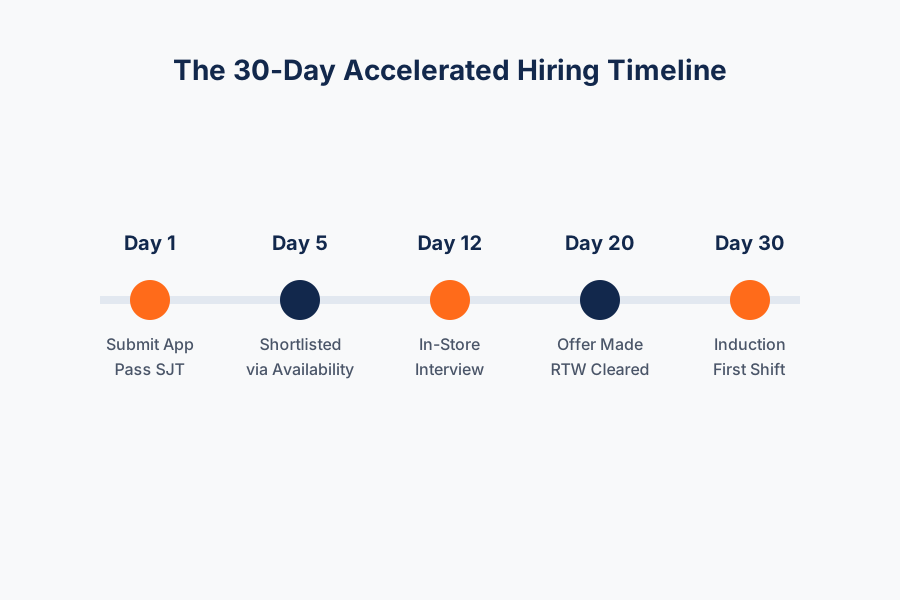
If you want to be hired within 30 days, you must manipulate this system to your advantage. Widen your availability to include the shifts that nobody else wants to work. Early mornings, late nights, and weekends are notoriously difficult for managers to cover. By making yourself available during these anti-social hours, you instantly outrank candidates with better experience but restricted schedules.
"I am completely flexible across all seven days of the week. I am particularly keen to take on early morning shifts and weekend work, and I can be available at short notice to cover unexpected absences."
Can I still walk into a Tesco store with my CV to get hired faster?
The official line from Tesco is that all recruitment is handled centrally through their online careers portal, leading many applicants to believe that handing in a physical CV is a waste of time. However, relying purely on the digital system puts you at the mercy of algorithms and high applicant volumes. A little-known tactic to bypass this waiting game is to combine the mandatory online application with a strategic in-person visit.
Store managers receive hundreds of generic applications every week. By visiting the store at a quiet time—usually mid-morning on a weekday—you can ask to speak to the Duty Manager. This demonstrates exceptional Proactivity and strong Communication Skills. You are not asking them to bypass the system; you are giving them a face and a personality to match to a name already in their digital queue.
When you make this visit, dress smartly but comfortably, exactly as you would for an interview. Be polite to every member of staff you encounter, as managers often ask the customer service desk for their first impressions of you. Keep the interaction brief and respectful of their time.
"Hi, I recently submitted my online application for the Customer Assistant role. I know everything is handled digitally, but I wanted to pop in, introduce myself personally, and let you know how eager I am to join your team. My name is [Name], and I'm fully flexible for shifts."
What is the fastest role to apply for if I need a job in 30 days?
If your primary goal is to secure a job at Tesco within a strict 30-day timeframe, you must be strategic about the specific roles you target. Applying for a standard daytime Customer Assistant role on the shop floor will put you in direct competition with the highest number of applicants, significantly slowing down the recruitment process. To get hired fast, you need to go where the demand is highest and the supply of candidates is lowest.
The roles that experience the highest turnover and require the most urgent hiring are Night Shift Replenishment and DotCom Pickers (the staff who fulfil online grocery orders). Store managers are frequently desperate to fill these positions to keep the store operational and meet strict delivery metrics. By applying for these roles, you demonstrate strong Adaptability and a willingness to tackle the hard graft that keeps the supermarket running.
Additionally, keep a close eye out for 'Festive' or 'Summer' temporary roles. Tesco hires thousands of temporary staff during peak periods, and the interview process for these roles is often streamlined to a single, brief conversation. Once your foot is in the door, it is entirely up to you to prove your worth and transition that temporary contract into a permanent position.
"I am specifically looking for high-paced, demanding roles like DotCom picking or night shifts. I thrive in target-driven environments and understand that these positions are the backbone of the store's daily operations."
How should I answer "Tell me about a time you went out of your way to help someone?"
This is the most common competency question asked in a Tesco interview, and it is designed to test your innate Empathy and dedication to Customer Service. Many candidates fail this question because they provide a generic answer about simply doing their job, such as helping a colleague finish a task or pointing a customer to the right aisle. Tesco wants to see evidence that you understand the difference between standard service and exceptional service.
To score highly, you must use the STAR method (Situation, Task, Action, Result) to structure your response. The 'Action' part of your answer must clearly demonstrate that you took ownership of a problem that wasn't strictly your responsibility. Did you call another store to find an out-of-stock item? Did you help an elderly person carry their shopping to their car in the rain? The key is to highlight the extra step you took.
Crucially, the 'Result' must focus on how your actions made the other person feel. Tesco's core values heavily emphasise treating people how they want to be treated. By concluding your answer with the positive emotional outcome, you prove that you are motivated by genuine care rather than just ticking a box.
"A customer was visibly distressed because she couldn't find a specific dietary product for her child. Instead of just checking our shelves, I went to the stockroom, found an unopened pallet, and retrieved the item. She was incredibly relieved and thanked me for saving her evening."
Why is my Right to Work check delaying my start date?
One of the most frustrating bottlenecks in the Tesco recruitment process occurs after a successful interview, during the mandatory Right to Work checks. Candidates often assume that because they have been offered the job, they can start immediately. However, Tesco's HR compliance is incredibly strict, and failure to provide the correct documentation in the exact format required can delay your start date by weeks, ruining your 30-day timeline.
This stage tests your Compliance and Attention to Detail. The automated system requires clear, uncropped, glare-free photographs of your passport, biometric residence permit, or birth certificate alongside an official proof of National Insurance. If the edges of the document are cut off in the photo, or if the name on your application does not perfectly match the name on your ID, the system will reject it and trigger a manual review process.
To bypass this delay, prepare your documents before you even submit your application. Scan them using a high-quality app rather than just snapping a hasty photo on your phone. If you are relying on a share code from the Home Office, generate it on the day of your interview and bring a printed copy with you. Proving that you are administratively organised makes you a highly attractive, low-maintenance hire for a busy manager.
| Common Mistake | Fast-Track Solution |
|---|---|
| Uploading a blurry photo of a passport. | Using a scanner app to create a perfectly cropped PDF. |
| Providing a nickname on the application. | Ensuring the application name matches the legal ID exactly. |
| Forgetting National Insurance proof. | Bringing physical P60 or official HMRC letter to the interview. |
How do I answer "What would you do if a customer was angry about an out-of-stock item?"
Retail environments are highly unpredictable, and dealing with frustrated shoppers is a daily reality. When interviewers ask this scenario-based question, they are actively assessing your Conflict Resolution skills and your overall Resilience. Candidates who suggest arguing back, becoming defensive, or simply telling the customer "there's nothing I can do" will be immediately rejected, as this escalates the situation and damages the brand's reputation.
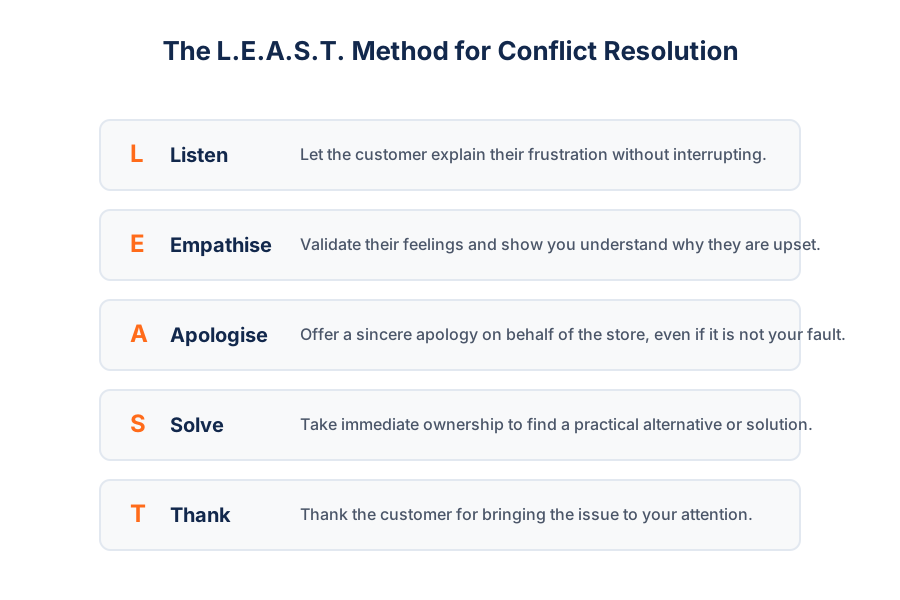
A strong answer must demonstrate the 'LEAST' method: Listen, Empathise, Apologise, Solve, and Thank. First, you must show that you would actively listen to the customer without interrupting, allowing them to vent their frustration. Second, you must validate their feelings. An out-of-stock item might seem trivial to you, but it could be the main ingredient for their family dinner. Showing genuine empathy diffuses anger faster than any corporate policy.
Finally, you must take ownership of the solution. Do not pass the blame to the delivery drivers or the warehouse team. Offer a tangible alternative, such as a similar brand, or offer to physically check the stockroom. Even if the item is truly gone, the customer will appreciate the visible effort you made on their behalf.
"I would listen to their complaint without interrupting and apologise for the inconvenience. I'd explain that while that specific brand is out of stock, I can show them a fantastic alternative, or I can quickly check the back warehouse just in case a new delivery has arrived."
How do I prepare for the 'Store Walk' or shop floor trial?
During many in-person Tesco interviews, the manager will ask you to leave the office and walk the shop floor with them. Many candidates mistake this for a casual tour and use the time to chat about irrelevant topics. In reality, the 'Store Walk' is a practical, silent assessment of your Commercial Awareness and your natural Attention to Detail. The manager is watching how you interact with the environment and the people within it.
As you walk down the aisles, you should be actively scanning the environment. If you see a piece of cardboard on the floor, discreetly pick it up. If you notice a product that has been knocked over, straighten it. These small actions prove that you instinctively take pride in the store's appearance and understand the basic principles of merchandising and safety without needing to be told.
Most importantly, acknowledge the customers. If you make eye contact with a shopper during the walk, smile and offer a polite greeting. Managers want to hire staff who naturally exude warmth and approachability. If you ignore the customers while trying to impress the manager, you have fundamentally misunderstood what the job entails.
"During my previous retail trial, I made sure to treat the shop floor as if I already worked there. I straightened a messy display while answering the manager's question, which demonstrated I could multitask and maintain store standards naturally."
How do I prove I align with the 'Every Little Helps' core values?
Tesco is a highly values-driven organisation, and their entire recruitment framework is built around three core pillars: "No one tries harder for customers", "We treat people how they want to be treated", and "Every little help makes a big difference". Candidates who fail to demonstrate an understanding of these values will struggle to progress, regardless of their previous retail experience. This assesses your overall Brand Alignment and cultural fit.
The biggest mistake applicants make is awkwardly reciting these values word-for-word when asked why they want to work for Tesco. This sounds robotic and insincere. Instead, you must weave the essence of these values into the stories you tell during the interview. When discussing teamwork, emphasise how you treated a struggling colleague with respect. When discussing problem-solving, highlight how a small, seemingly insignificant action made a massive difference to an outcome.
Before your interview, write down one personal experience that perfectly encapsulates each of the three values. By doing this, you will have a mental arsenal of authentic stories that naturally prove you possess the exact mindset the interviewer is looking for.
"I believe that small actions compound into great service. In my last job, simply taking the time to learn the names of our regular customers completely transformed the atmosphere in the shop. I know this aligns perfectly with the idea that every little help makes a big difference."
How do I answer "Tell me about a time you worked in a team to achieve a goal?"
Supermarkets operate on a massive scale, and absolutely nothing is achieved in isolation. When interviewers ask about your past group experiences, they are evaluating your Teamwork and Collaboration skills. A common pitfall is using the word "we" too often, which dilutes your personal impact and leaves the interviewer wondering what your actual role was in the success of the project.
To construct a compelling answer, you must clearly define the shared goal, but heavily emphasise your individual contribution. Did you take on extra work when a team member called in sick? Did you help mediate a disagreement between two colleagues? Tesco managers are looking for team players who elevate the people around them, not just individuals who keep their heads down and do the bare minimum.
Always highlight your willingness to communicate openly and share the workload. A highly effective technique is to describe a high-pressure situation—such as a busy holiday rush or a sudden deadline—and explain how you maintained a positive attitude and kept the team motivated through a difficult shift.
"During the Christmas rush at my previous job, we were severely understaffed. I noticed a new colleague was overwhelmed on the tills, so I stepped in to bag the items for them while managing the queue. By communicating clearly and sharing the load, we cleared the backlog without any customer complaints."
What should I expect at a Tesco Group Assessment Centre?
For certain high-volume intakes, especially during the festive season or for new store openings, Tesco uses Group Assessment Centres to evaluate dozens of candidates simultaneously. Many applicants find this environment highly intimidating and mistakenly believe they must shout the loudest or take charge of every task to be noticed. In reality, dominating the room is the fastest way to fail, as it shows a severe lack of Interpersonal Skills and Active Listening.
The assessors are not necessarily looking for the person with the best ideas; they are looking for the person who makes the team function best. You will typically be given a collaborative task, such as prioritising a list of urgent store issues or building a display out of basic materials. Your goal is to demonstrate that you can facilitate a productive discussion.
The ultimate trick to passing a group assessment is to act as the team's anchor. Keep an eye on the time, summarise the group's progress, and most importantly, invite quieter members to share their thoughts. By saying, "We haven't heard from Sarah yet, what do you think?", you instantly prove to the assessors that you possess natural leadership and deep empathy.
| Failing Behaviour | Winning Behaviour |
|---|---|
| Interrupting others to share your own idea. | Building upon someone else's idea positively. |
| Ignoring the quiet members of the group. | Directly asking quiet members for their input. |
| Arguing to ensure your solution is chosen. | Compromising to reach a consensus quickly. |
How do I turn a 30-day temporary contract into a permanent job?
Securing a temporary role is often the easiest and fastest way to get a foot in the door at Tesco within 30 days. However, the real challenge is convincing the store manager to keep you on permanently once the busy season ends. Many temporary workers treat the job as a short-term gig, doing the bare minimum and rushing out the door the minute their shift ends. To secure a permanent contract, you must demonstrate unparalleled Reliability and a relentless Work Ethic.
You must treat your entire temporary contract as a month-long interview. This means arriving ten minutes early for every single shift, ensuring your uniform is pristine, and never calling in sick unless it is a genuine emergency. Managers talk, and the first thing a Store Manager will ask the Shift Leaders at the end of the season is, "Who turned up on time and didn't complain?"
To truly stand out, actively volunteer for the tasks that other staff avoid. Offer to do the cardboard baling, clean up spills without being asked, or stay an extra fifteen minutes to help finish off a delivery cage. By making yourself indispensable and solving problems before the manager even notices them, you make it administratively and operationally impossible for them to let you go.
"I know I am only here on a temporary contract, but I want to treat this role as if I am a permanent member of the team. Please let me know if there are any extra shifts to cover or less popular tasks that need doing, as I am eager to prove my value."